Friday, October 28, 2011

Lock-In? Please...

In the last 4 months, I've talked to over 70 companies about Platform as a Service --> PaaS. Big companies. Small companies. Companies that make stuff. Companies that service other companies. Companies that represent business in America.

As with any emerging technology, the conversations are almost always educational (both ways) and spirited. And it's a lot of fun to figure out new ways we can improve their businesses.

Of course, they have concerns. Being new to the job, one concern I expected to hear was "vendor lock-in". After all, some analysts have pointed it out as a big deal. So I listened, listened some more, and took copious notes. 70 customers later, the percentage that list "lock-in" as a problem speaks volumes:

Zero.

Instead, I'm hearing a lot of quotes like this:

  • "We need to move fast and innovate"
  • "Let's choose the best tool for the job"
  • "I want to leverage our existing skills"
  • "Everything is going mobile"
  • "We need flexible business models and a vendor that thinks like a partner"

Lock-in? Just another invention of ivory-tower analysts. I'll focus on real business problems at real companies instead.

To my customers: the Force is with you. Heroku, too.

JMF

Monday, August 8, 2011

Move fast, securely

For those who haven't heard, I've recently joined Salesforce.com working on the Platform business. It's great to be in a new place, on a growing team, working on a growth market (According to Gartner, anyway).

In my few few weeks, I've talked to about a dozen customers who all spin a similar story:

With an array of new technologies available to IT professionals, productivity gains are only going to increase in the coming years. Ruby was a catalyst, new languages continue to pop up, and even Java is keeping pace with new frameworks to accelerate deployment in the Enterprise. Programmers are turning into polygot programmers, which is an accurate (if not amusing) term I've learned.

Putting this new power on a secure platform gives the CIO the ability to grow the business with increased productivity, while maintaining a central governance point to enforce enterprise security.

Sounds like the best of both worlds to me...

Tuesday, April 26, 2011

SaaS Benchmarking

I enjoyed reading this post by Dave Kellogg on SaaS, which summarizes a really nice BVP piece. I took particular note of axiom #8:

"Leverage and monetize the data asset. You can do this by leveraging your expertise to identify the metrics and dashboards of most analytic value and further by then selling industry benchmark data on them. This, to me, is one of the more obvious SaaS opportunities, yet nevertheless to-date, in my experience, one of the most unexploited. I expect to see much more progress in this area in the coming few years."

Having spent a good amount of time over the past year working on this, I know it's a great opportunity, but it's not a simple problem to solve. If you're going to tackle it, take note:
  • Build your application vision first. Make no mistake, treating this as an application (as opposed to a data feed) frees your mind from worrying about the technical challenge, which will come later. Get on a whiteboard, sketch on a napkin, gather around the campfire in order to...
  • Define some good metrics. It's an analytical application at its core, which revolves around measurements, dimensions, and comparisons thereof.
  • Broaden your technical horizons. To pull it off, you'll likely need several components or tools, including Database, ETL, Statistical Programming, Business Intelligence, and UI and Data Discovery Frameworks. Each adds value at each step in the data lifecycle, but also must be carefully orchestrated. Software advancements in most of these domains are scorching right now. That's great news for developers, but also requires diligent oversight to make sure everything works together. I've listed some of the important ones below, linking to IBM pages with more detail.
In most ways, these concepts aren't new. Data providers have been turning aggregated metrics into commercial assets for decades. But the explosion of SaaS combined with new technical advancements are creating new opportunities for insight into processes and metrics that, until now, were confined to the walls of individual companies.

IBM Links

Wednesday, November 24, 2010

Hey, it's complicated!

Reading the most recent blog post by James Kobielus, my mind is spinning from the array of options that you might want to use to differentiate on Analytics. And, as James aptly points out. none of these technologies are designed for use by the masses, let alone executives.

With analytics technology spend increasingly being spread out to the "masses" (departments, even end users), how can you get projects off the ground? It seems to me:

  • Start big, or start small, but don't start in the middle. Presenting a radical transformation can get you in the door with executives. From there, you might scale down to a piece of the puzzle that's practical to implement. Or, you can find a small, high-value problem with a defined solution for a quick win. From there expand into other advanced analytics areas (land and expand isn't dead). But going somewhere in between seems too complex for the return -- keep your big vision big, or your small project in scope until the deal is won.
  • Know your customer. And I mean really know your customer, and everything they do. This is a little more than perusing the website and listing to the earnings calls. Understand their industry, culture, vision, and competitors. That business context is the only way to sell something this complex.
  • Dig in for a long ride. These technologies aren't getting simpler. While there's potentially massive value to be had, it will take time, as will your sales cycles.


Thursday, November 11, 2010

Define Your Analytics Priority

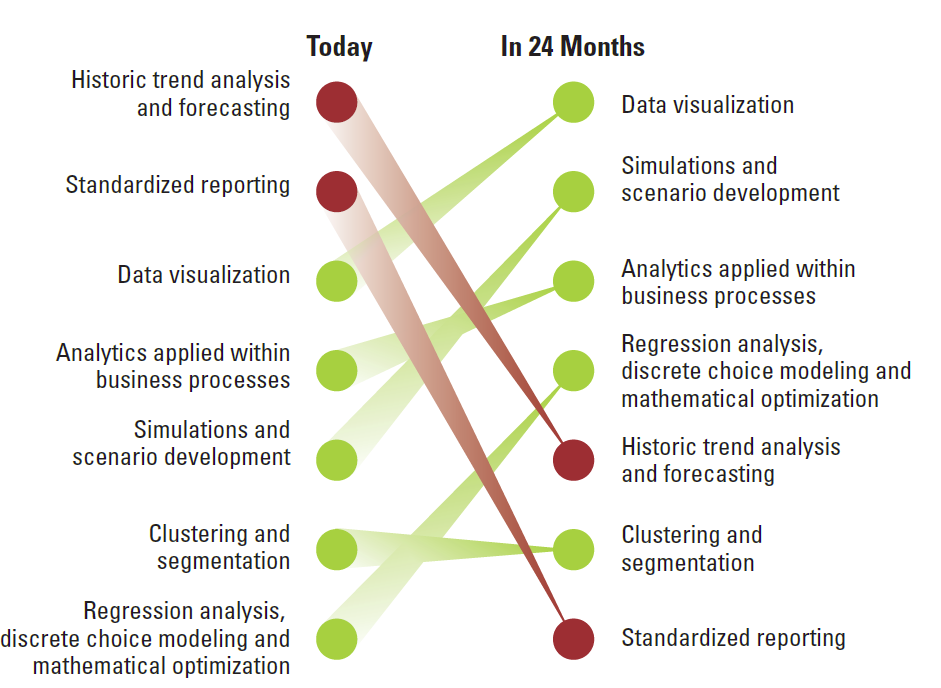
I've read the recent IBM and MIT research report, and I think it's worthwhile reading for organizations building their analytics strategy. There's some great advice:
  • Start with questions, not data.
  • Embed insights to drive action.
  • Top performers view analytics as a differentiator.
  • Analytics are important for both operational and strategic initiatives.
  • Information must become easier to understand.
  • Analytics initiatives will not be delivered by IT
I take issue with a couple of points in the study. I think the definition of "data visualization" in the report is too loosely defined -- especially given the "easier to understand" directive noted above. And I strongly disagree that there are "standard tools" to enable the transformed organization, nor should that be the focus.

The digram below does a nice job showing how the priorities in analytics are changing, and can help guide your investment and priority (with the Analytics Quadrant, of course).


Thursday, November 4, 2010

"There is no Silver Bullet"

I find myself uttering that phrase a lot lately. Maybe it's because business hasn't quite rebounded, despite modest improvements over last year. But everyone seems to want an easy fix -- especially in technology, where boom times are simply expected, and often not earned.

Pipeline is the lifeblood of any sales organization, and Jeff Ogden hits the nail on the head in his recent blog entry on SandHill.com

I don't know Jeff, but three cheers for sanity.

-------------------------------

...But to become the best, you need to make a BIG commitment. You need to invest serious sweat and patience in the foundation of demand generation:Only by really working hard on understanding buyers, their issues, their problems, etc. will you have the insights to craft a world-class demand generation program. Don't short cut this process. Nothing in life is easy.

-------------------------------

Thursday, October 28, 2010

Coming off IBM's IOD conference, I've been trying to figure out how to position the breadth of the platform so that our partners (ISVs, SaaS companies, BPOs or consulting firms) can build product strategy around the next wave of analytic applications. The potential value of these applications is a hot topic, but how can we capitalize on it? While the breadth of the IBM platform is unmatched, it's tough to figure out where to start.

So, here we go. Use the Analytic Applications Quadrant below in your product strategy sessions, with your investors, or even your clients. And, of course, work with your IBM team to define and build your solutions across these different domains. Leave a comment, or shoot me an email with your thoughts...


X-Axis: Customer Awareness

The x axis of customer awareness is an indication of how much your customers have heard about these particular solutions. It's largely a factor of industry trends and marketing, media coverage, and focus by major technology providers, including IBM.

Y-Axis: Market Expectation

The y axis of market expectation measures the expectation that your solution(s) include the analytics categories. It's generally an indication of the maturity and adoption of the category in the enterprise.

The categorical representation breaks down as follows:

Core Functionality

Solutions that are generally expected to be delivered as part of your solution. They represent technologies that are generally pervasive in the enterprise across most, if not all, domains and industries.

While there may be business models that monetize solutions in this category, we believe the majority of solutions will be incorporated "out-of-the-box" in business software with no additional line item cost or surcharge.

Thought Leadership

These solutions generally have maturity in specific domains or industries, but have the potential to be applied more broadly. Customer awareness may be limited outside specific business units, but there are identified applications that improve business processes or user experience.

A common example is scenario planning. While planning using advanced technologies has been standard practice in Finance for many years, there are many identified applications for the technology outside financial processes that improve business decisions.

The business potential of these application is mixed. It may be a small component of an application or business process. In some cases, it may represent a potential up charge or micro application that can be sold.

Point Solutions

These analytic technologies satisfy specific use cases or industries. They haven't proven to have general applicability, but can be critical for certain business processes. As a result, these solutions can generally be sold to solve a specific problem.

A common example would be operational monitoring in a call center application measuring call volumes and wait times.

Strategic Differentiation

The next wave of widely deployed analytic applications will likely include these technologies, and they will give your products and your firm measurable ROI. While these solutions have substantial media attention and marketing from leading technology companies, their practical implementations are still small in number at the enterprise level -- they represent substantial opportunity for your company to build high margin businesses.