Thursday, December 5, 2013

Any.do

I've long searched for the perfect to-do app. I was a power-user of rememberthemilk for a few years. As much as I liked its flexibility, ultimately the interface, both mobile and desktop, was too cumbersome.

Any.do might be the answer. It has the cleanest, smartest interface I've encountered. The Chrome plug-in is brilliant. It clearly has a mobile-first design (let's face it, to-do lists are most valuable when you are away from your computer).

For any to-do app to work, you have to want to use it. Any.do seems to be just that. Like any startup, I hope they can find the resources to keep it going, and keep improving. The email-to-task function could be better (I have multiple email addresses to use), and the iOS integration appears to lag slightly behind Android.

The rabbit-out-of-the-hat trick would be Salesforce.com integration...since the only thing less productive than not keeping a to-do list is managing that list in SFDC (RIP do.com!).

Sunday, November 3, 2013

Tolosa

It's time for a wine post. I still drink it, in case you were wondering.

Some notes below on Tolosa, a super little winery in the Edna Valley near San Luis Obispo. We hit it when we were down in Pismo Beach last month. It's definitely worth a stop if you are in the area. 

Some tasting notes on wines we picked up, all estate grown:
  • 2012 "No Oak" Chardonnay. A really nice fruit-forward Chardonnay that's a welcome change from heavier efforts in Northern California. It's almost French-style, crisp and light, and would pair well with shellfish, chicken, or just some crackers on a warm day.
  • 2011 Pinot Noir. The Central Coast is a good Pinot region, and this wine picks up some of those characteristics. It's medium bodied and earthy. I actually enjoyed it a bit more at the winery than my first bottle at home, which was sharper than I remembered. Still, if you like Pinot you should pick it up.
  • 2010 Syrah. I don't usually go out of my way to drink Syrah. While I was there we tasted it, I thought it was pleasant, so we picked up a few bottles. It was far better than I remembered when we got home. It has a pepper spice that really pops when you sip it, but is smooth on the finish with a bit of citrus. It's a great wine, and I wish I bought more of it (I guess it's an excuse for a return trip).

 The people down at Tolosa are really friendly, know their stuff, and the grounds are beautiful. I'm definitely looking forward to returning, for more Syrah if nothing else!

Wednesday, October 2, 2013

Met expectations...

Sometimes, when you extend into the edges of the product you sell, you don't know what to expect. So, when I had a question from a customer about Google Analytics, I thought I'd try it myself. If you're a regular reader of my blog, you know I track everything. 

Of course, I'm the only regular reader of my blog. But humor me!

Tableau makes visualizing Google Analytics dead simple. Like, "this is so simple why would I ever do it another way" simple.

It goes like this:

  • Choose the Google Analytics Data source
  • Sign in to Google
  • Choose your property and profile
  • Choose your date range, measure group, and dimensions
Then, drag and drop in Tableau as you would any data source.


What makes Tableau great is not just that new features are added, it's that they are added (in the words of our leadership) the "Tableau Way" - simple and elegant. I guess I've used (and built) enough software that was - ahem - inelegant, so I appreciate a good thing when I use it.

If I were in Marketing for a living, this would be a must have. Especially if I'm doing some A/B testing (shout out to Optimizley). I'm not in Marketing, but I like most of the Marketing people I meet. They tend to send well-formatted emails, which is a dying art in our society.

For me, I just want to see if I can come close to the popularity of Big Daddy Paul. Doubtful, but a guy can dream.

Disclaimer: I work for Tableau. But it really is that easy.

Wednesday, August 21, 2013

Selling and racing...

Every sales review is a chance to reflect. Since we had an epiphany last week, my first at Tableau, it's time to share some thoughts.

Sales goals bring me back to 2009, when I was in the middle of training for Escape from Alcatraz. The prospect of swimming across the San Francisco Bay with 2000 other people struck plenty of fear in me, and fear is a tremendous motivator. So I talked it up, out of pride, and out of nerves, and all my co-workers were part of my training squad, in spirit.

A friend on my sales team at the time asked me 2 months before the race: "What is your goal, to win?"

This, I thought at the time, is a really good question. After all, I'm competitive. Of course I want to win. But this simply wasn't going to happen. I was competing against profesionals, experienced age-groupers who had raced it before, and some people who were just better suited for Escape.

But does this mean I shouldn't try to win?


I stepped up my swimming leading up to the race


At a prior company, at a sales kickoff meeting, all sales people were encouraged to write down their 3 goals for the year. "Think big!" "Don't settle for 100% of quota!" "Shoot for #1!!!" and other lofty objectives were encouraged by sales leadership. Everyone dutifully wrote down "300% quota!" "#1 Sales Rep!" and other goals that would be put up in cubicles and on monitors on every sales floor. 

But here's the problem with lofty goals: they don't make you successful. As I was training for Escape, if I had simply written down "Goal: win the race" - I would have done myself a disservice. Instead, I wrote down my training objectives, 3 things that would make me a better triathlete, and give me a chance to win:

  • Improve in the water: training swims at least 4x per week
  • Diet: maintain my optimal race weight during training
  • Hills: add elevation to every training session to get faster
Instead of focusing on winning, I focused on the things I needed to do to put myself in position to win. And by doing that, I went to the start line with one mindset: to win the race.

For the record, I finished 411th

Tuesday, June 25, 2013

Salesforce & Oracle

The Salesforce/Oracle partnership has been widely reported, but here are a few points that probably weren't:

It's symbolic for Heroku

When the Heroku acquisition was announced, it sure sounded like the next generation Salesforce Platform. Heroku's shared-nothing approach and open standards fix two oft-leveled criticisms of Force.com. But it's an uneasy relationship, at best, with little coordination (how long does it take you to find mention of Salesforce on the Heroku website) and departure of many key Heroku execs in recent months.

It relegates Salesforce's HR strategy to the periphery

Many speculated that the launch of Work.com would be the start of a full-on assault in the HR software market. But this agreement seems to boost Oracle HR applications, while Salesforce stays in their defined niche of employee perks and social performance reviews.

It's good for Workday.

Workday is already competing with Oracle. This takes away the threat of competing with Salesforce, which in some ways would be much more difficult. Sure, they lose a customer, but that's a good trade.

There's still a place for Postgres.

The Salesforce application underpinnings are in dire need of an upgrade. But who's to say Postgres won't be a part of that? I haven't seen anything that indicates this is an exclusive relationship, even if it is for 9 years...


Monday, May 27, 2013

I have an awesome new job

So, you have a new job...

That line, or a variation thereof, has been sent to me dozens of times in the past month. I've taken 2 things from it:
  • I'm very, very grateful for the outpouring of support from friends and colleagues.
  • A lot of people I know are searching for something different in their own careers.

On the first point, many thanks to many great people I have the privilege of knowing and calling my friends.

On the second point, I want to feel valued for my experience, but challenged to get better every day. Just like many of you. Some points from my job search:

  • Interview. A lot. There's absolutely no downside to taking an interview. Like anything else, the more you do it, the better you'll get. Informational interviews are a great way to practice.
  • Find the right role. A lot of companies, good companies, will try to sell you on a role you might not want as a "foot in the door" or "a way in" a company that you admire. You have to be 100% passionate about the job you have here and now. It does neither you nor the company any good to take a job with the expectation that "something better" will come along. So...
  • Be patient. It's easy to want to jump at the first thing that's better than where you are, but you owe it to yourself to wait for the job that will get you fired-up to get after it every day. Figure out what that is for you, and don't make a move until you find it.
  • As a candidate, recruiters work for you. Once you get past the initial interview, recruiters (external and internal) have incentive to get you in. Use them to sell for you when you aren't there. Get them to give you insight into the people, the decision making process, and the company culture. Keep asking them questions, and questioning their answers.
  • Always be open, honest, and professional. I've heard different schools of thought when it comes to interviewing. I heard advice on "playing your cards" and "negotiating the deal." But I think it's best to be honest and upfront with everyone, from the admin to the CEO. The whole thing is really unique: good companies are in demand, as are good people. Both sides have to agree to make it work, and both sides will always have options for any given role. Good companies, and good candidates, will communicate and negotiate with honesty and transparency. 
With that, I can honestly say I'm incredibly happy with the choice I made. And, by the way, we're hiring.

Cheers!

Wednesday, June 20, 2012

Mobile and Enterprise Applications: Answers Questioned

I've been talking a lot about mobility with customers over the last several weeks. It's top of mind with the release of the Mobile SDK 1.2, which makes it simple to create mobile applications for just about anything. Some common themes from customers:
  • Mobile use cases are different. Many (if not most) need to be quick logging of activities. It's not working through a complex business problem on your iPhone.
  • An analogy from consumer software is Foursquare versus Facebook. Foursquare is fast, designed to get a user in and out of the application in seconds. Facebook is designed to hold your attention for minutes (heck, hours if you're stuck in the airport).
  • Like Foursquare, there should be no barrier to the end user for mobile data entry: logging a sales activity, a shipment, an idea. And geo-location tags make that even easier. 
  • Like Facebook, users will need to connect with others in the company. And almost all users need some kind of document library available. That generally dovetails into social media business requirements.
  • BYOD just makes sense, it's ultimately much easier for most businesses to support, and is one less thing to manage. So HTML5 will be a natural design choice for a lot of this...even more so as the specification and support evolves.
Ultimately, progressive companies want to use mobile trends as a competitive advantage. Obviously, mobile personnel become more productive. But capturing more data, and more accurate data, will eventually lead to more agile, productive businesses. And that's where it gets interesting...


Tuesday, January 31, 2012

Random thought of the day.

As an avid news consumer with daily commute time to keep me captive, I spent time over the summer experimenting with the best ways to catch up on daily events on my iPhone. Sure, I love my iPad, but when I'm standing on a crowded train, my iPhone is easier to hold and control. Besides, I'm almost never without my iPhone at home or on the road - I have more moments to steal some productivity with my iPhone than any other device.

Last summer, Scribd announced Float, which on the surface looked perfect: a single user interface for any content I want. No more Twitter hyperlinks to poorly designed websites, or trying to manage everything with Google Reader. One app, one place to go, finally.

One problem: the app didn't work.

I downloaded Float on my iPhone 4 the day it launched, and quickly setup a few key content feeds from the list. While not everything on the web was accessible, it was a good enough selection to get get started. On the first day, it seemed to crash and close every second article or so. Many articles failed to load. But, hey, it just came out, so I gave them some slack.

Over the next week or two, it seemed that Float had an update to push every day. Every time, stability seemed to get worse. The user interface had a confusing preview feature you could kind of use by sliding over the article, and that itself would crash the application on occasion. After about 2 weeks, I grew tired of the constant updates, user interface, and instability. So I stopped using it.

In December, Flipboard launched their iPhone app, about 5 months after my Float experience. Flipboard for the iPad may be the most elegant piece of software I've ever used, and the iPhone app promised the same 1-stop interface Float had promoted. So I tried it.

The iPhone interface is every bit as spectacular as the iPad experience. The smaller form factor requires some design changes, of course, but the user features and the content presentation are outstanding. The presentation of my Twitter and Facebook content may never replace the iOS clients for those applications, but the ability to present the content linked in my social feeds is unparalleled.

So I use Flipboard, and I'll never go back to Float. Flipboard wasn't the first to market, not even close. But they did it right, which ultimately was more important than being first.

Lesson learned.

Tuesday, December 13, 2011

SAP HANA - system of engagement?

Used Evernote for today's SAP thoughts. They still don't get it.

https://www.evernote.com/shard/s5/sh/0a3dce0a-0d86-45dd-8c74-aa3321006bb6/26e71076b80d00d5e4d7eb76744ece83

Saturday, December 3, 2011

Big Software Perils

This Gartner analysis of the "big" software companies is fantastic. I've talked to 100+ customers over the past 5 months, and most of them are in 2 ERP camps:

  • Support mode: Hey, we all need a ledger. But let's face it, you shouldn't be investing 25% in SAP or Oracle systems that not only will never innovate, don't need to. My friends at Rimini Street are building a robust business, with good reason.
  • Upgrade mode: let's face it,if you are running SAP or Oracle ERP, you're always upgrading. When upgrade projects take years, by the time you've rolled it out across all instances, users, and geographies, it's time to start doing it all over again. But the "value" of the upgrades? Mostly for hardware compliance, software compliance, internationalization.

Is there an innovation mode? Not with the major ERP players. Many customers are looking for an innovation platform that allows them to build fast, with minimal IT impact. An army from IBM or Microsoft won't work for the average American business, either.

The more I read about the state of software today, the happier I am to be at Salesforce.com.


Friday, October 28, 2011

Lock-In? Please...

In the last 4 months, I've talked to over 70 companies about Platform as a Service --> PaaS. Big companies. Small companies. Companies that make stuff. Companies that service other companies. Companies that represent business in America.

As with any emerging technology, the conversations are almost always educational (both ways) and spirited. And it's a lot of fun to figure out new ways we can improve their businesses.

Of course, they have concerns. Being new to the job, one concern I expected to hear was "vendor lock-in". After all, some analysts have pointed it out as a big deal. So I listened, listened some more, and took copious notes. 70 customers later, the percentage that list "lock-in" as a problem speaks volumes:

Zero.

Instead, I'm hearing a lot of quotes like this:

  • "We need to move fast and innovate"
  • "Let's choose the best tool for the job"
  • "I want to leverage our existing skills"
  • "Everything is going mobile"
  • "We need flexible business models and a vendor that thinks like a partner"

Lock-in? Just another invention of ivory-tower analysts. I'll focus on real business problems at real companies instead.

To my customers: the Force is with you. Heroku, too.

JMF

Monday, August 8, 2011

Move fast, securely

For those who haven't heard, I've recently joined Salesforce.com working on the Platform business. It's great to be in a new place, on a growing team, working on a growth market (According to Gartner, anyway).

In my few few weeks, I've talked to about a dozen customers who all spin a similar story:

With an array of new technologies available to IT professionals, productivity gains are only going to increase in the coming years. Ruby was a catalyst, new languages continue to pop up, and even Java is keeping pace with new frameworks to accelerate deployment in the Enterprise. Programmers are turning into polygot programmers, which is an accurate (if not amusing) term I've learned.

Putting this new power on a secure platform gives the CIO the ability to grow the business with increased productivity, while maintaining a central governance point to enforce enterprise security.

Sounds like the best of both worlds to me...

Tuesday, April 26, 2011

SaaS Benchmarking

I enjoyed reading this post by Dave Kellogg on SaaS, which summarizes a really nice BVP piece. I took particular note of axiom #8:

"Leverage and monetize the data asset. You can do this by leveraging your expertise to identify the metrics and dashboards of most analytic value and further by then selling industry benchmark data on them. This, to me, is one of the more obvious SaaS opportunities, yet nevertheless to-date, in my experience, one of the most unexploited. I expect to see much more progress in this area in the coming few years."

Having spent a good amount of time over the past year working on this, I know it's a great opportunity, but it's not a simple problem to solve. If you're going to tackle it, take note:
  • Build your application vision first. Make no mistake, treating this as an application (as opposed to a data feed) frees your mind from worrying about the technical challenge, which will come later. Get on a whiteboard, sketch on a napkin, gather around the campfire in order to...
  • Define some good metrics. It's an analytical application at its core, which revolves around measurements, dimensions, and comparisons thereof.
  • Broaden your technical horizons. To pull it off, you'll likely need several components or tools, including Database, ETL, Statistical Programming, Business Intelligence, and UI and Data Discovery Frameworks. Each adds value at each step in the data lifecycle, but also must be carefully orchestrated. Software advancements in most of these domains are scorching right now. That's great news for developers, but also requires diligent oversight to make sure everything works together. I've listed some of the important ones below, linking to IBM pages with more detail.
In most ways, these concepts aren't new. Data providers have been turning aggregated metrics into commercial assets for decades. But the explosion of SaaS combined with new technical advancements are creating new opportunities for insight into processes and metrics that, until now, were confined to the walls of individual companies.

IBM Links

Wednesday, November 24, 2010

Hey, it's complicated!

Reading the most recent blog post by James Kobielus, my mind is spinning from the array of options that you might want to use to differentiate on Analytics. And, as James aptly points out. none of these technologies are designed for use by the masses, let alone executives.

With analytics technology spend increasingly being spread out to the "masses" (departments, even end users), how can you get projects off the ground? It seems to me:

  • Start big, or start small, but don't start in the middle. Presenting a radical transformation can get you in the door with executives. From there, you might scale down to a piece of the puzzle that's practical to implement. Or, you can find a small, high-value problem with a defined solution for a quick win. From there expand into other advanced analytics areas (land and expand isn't dead). But going somewhere in between seems too complex for the return -- keep your big vision big, or your small project in scope until the deal is won.
  • Know your customer. And I mean really know your customer, and everything they do. This is a little more than perusing the website and listing to the earnings calls. Understand their industry, culture, vision, and competitors. That business context is the only way to sell something this complex.
  • Dig in for a long ride. These technologies aren't getting simpler. While there's potentially massive value to be had, it will take time, as will your sales cycles.


Thursday, November 11, 2010

Define Your Analytics Priority

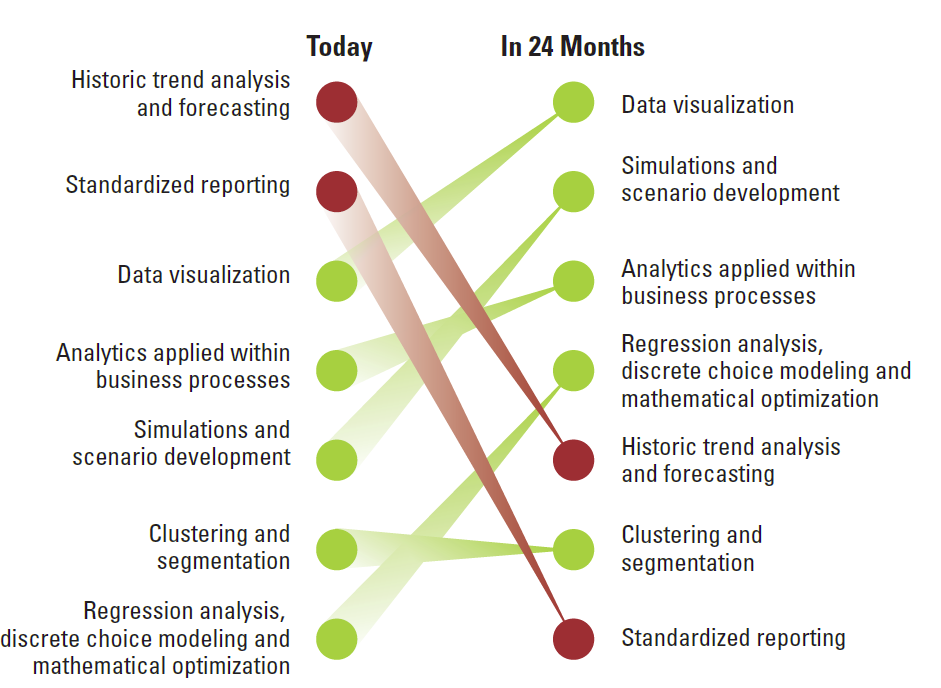
I've read the recent IBM and MIT research report, and I think it's worthwhile reading for organizations building their analytics strategy. There's some great advice:
  • Start with questions, not data.
  • Embed insights to drive action.
  • Top performers view analytics as a differentiator.
  • Analytics are important for both operational and strategic initiatives.
  • Information must become easier to understand.
  • Analytics initiatives will not be delivered by IT
I take issue with a couple of points in the study. I think the definition of "data visualization" in the report is too loosely defined -- especially given the "easier to understand" directive noted above. And I strongly disagree that there are "standard tools" to enable the transformed organization, nor should that be the focus.

The digram below does a nice job showing how the priorities in analytics are changing, and can help guide your investment and priority (with the Analytics Quadrant, of course).


Thursday, November 4, 2010

"There is no Silver Bullet"

I find myself uttering that phrase a lot lately. Maybe it's because business hasn't quite rebounded, despite modest improvements over last year. But everyone seems to want an easy fix -- especially in technology, where boom times are simply expected, and often not earned.

Pipeline is the lifeblood of any sales organization, and Jeff Ogden hits the nail on the head in his recent blog entry on SandHill.com

I don't know Jeff, but three cheers for sanity.

-------------------------------

...But to become the best, you need to make a BIG commitment. You need to invest serious sweat and patience in the foundation of demand generation:Only by really working hard on understanding buyers, their issues, their problems, etc. will you have the insights to craft a world-class demand generation program. Don't short cut this process. Nothing in life is easy.

-------------------------------

Thursday, October 28, 2010

Coming off IBM's IOD conference, I've been trying to figure out how to position the breadth of the platform so that our partners (ISVs, SaaS companies, BPOs or consulting firms) can build product strategy around the next wave of analytic applications. The potential value of these applications is a hot topic, but how can we capitalize on it? While the breadth of the IBM platform is unmatched, it's tough to figure out where to start.

So, here we go. Use the Analytic Applications Quadrant below in your product strategy sessions, with your investors, or even your clients. And, of course, work with your IBM team to define and build your solutions across these different domains. Leave a comment, or shoot me an email with your thoughts...


X-Axis: Customer Awareness

The x axis of customer awareness is an indication of how much your customers have heard about these particular solutions. It's largely a factor of industry trends and marketing, media coverage, and focus by major technology providers, including IBM.

Y-Axis: Market Expectation

The y axis of market expectation measures the expectation that your solution(s) include the analytics categories. It's generally an indication of the maturity and adoption of the category in the enterprise.

The categorical representation breaks down as follows:

Core Functionality

Solutions that are generally expected to be delivered as part of your solution. They represent technologies that are generally pervasive in the enterprise across most, if not all, domains and industries.

While there may be business models that monetize solutions in this category, we believe the majority of solutions will be incorporated "out-of-the-box" in business software with no additional line item cost or surcharge.

Thought Leadership

These solutions generally have maturity in specific domains or industries, but have the potential to be applied more broadly. Customer awareness may be limited outside specific business units, but there are identified applications that improve business processes or user experience.

A common example is scenario planning. While planning using advanced technologies has been standard practice in Finance for many years, there are many identified applications for the technology outside financial processes that improve business decisions.

The business potential of these application is mixed. It may be a small component of an application or business process. In some cases, it may represent a potential up charge or micro application that can be sold.

Point Solutions

These analytic technologies satisfy specific use cases or industries. They haven't proven to have general applicability, but can be critical for certain business processes. As a result, these solutions can generally be sold to solve a specific problem.

A common example would be operational monitoring in a call center application measuring call volumes and wait times.

Strategic Differentiation

The next wave of widely deployed analytic applications will likely include these technologies, and they will give your products and your firm measurable ROI. While these solutions have substantial media attention and marketing from leading technology companies, their practical implementations are still small in number at the enterprise level -- they represent substantial opportunity for your company to build high margin businesses.

Wednesday, January 13, 2010

Need...More...Oxygen!

Oxygen is unquestionably my favorite element on the periodic chart. It's easy to remember, has great marketing appeal for all sorts of products (hey to Oxy-Clean), and is an important part of water, my favorite compound. So when someone tells me to go without it for my own good, I tend to be a little skeptical.

But that's exactly what happened today. After a really tough swim workout (okay, most swim workouts are tough for me, but today's was especially hard), our coach has the great idea to finish practice with "no-breathers." For you land-lovers, no-breathers are drills where you swim laps without breathing. You know, straining your muscles and organs, simultaneously depriving them of air. The guy in the lane with me thinks this is a great idea, but I'm pretty sure he's half fish.

Coach encourages us by saying "these will get easier the more you do" -- which I think is like saying "hitting yourself in the head with a hammer will hurt less once you crack your skull." But on about the 3rd lap, that's exactly what happened.

After 2 laps of flailing to the point of passing out, I figured out the secret: stop trying so hard. The goal remained the same, of course, to swim across the pool without a breath. But taking my standard brute-force approach to swimming didn't work. It required more finesse, more technique, and a slower pace. In doing so, I got more distance out of the oxygen I took in.

In a way, this is exactly what many of us face every day. Companies everywhere have cut staff. As managers and leaders, we're asked to produce the same results with less resources. Our employers aren't just asking us to do no-breathers, they're expecting it.

And while our natural response to this is to work harder, push harder, and power our way through it, it's not necessarily a path to success. To get to the other side, we have to do things differently, use our talents and minds in new ways, and achieve more with less. Just applying more effort isn't enough.

The moral of the story? The next time your boss, shareholders, board of directors, or employees ask more of you, just hold your breath until you turn blue. That'll show 'em.

Tuesday, January 5, 2010

2010: Resolutions

Resolutions can be hard to keep, so I took a look back at my resolutions from 2009, and realize that I actually did okay.

Now, for 2010:
  • Correspond to connect: based on a fantastic post by Steve Rubel, I'll be upping my correspondence: particularly the one-to-many correspondence here. I had thought of a writing resolution, but Steve makes it sound so much more 21st century!
  • Innovate: Chris O'Brien's blog post on the innovation bias at Sequoia was both funny and sad. While I know that attitude isn't universal in the industry, I fully admit I did my best innovating before age 30. Why that trend has declined in the past several years is probably the subject of another post. If I can prove Sequoia wrong in 2010, at least in my own mind, I'll gain a small slice of personal satisfaction.
  • Discipline: Be exact about my training regimen, diet, finances, and work. Focus, and refocus, to get the most out of every minute of the day. Time is precious.
  • Improve Every Day: Take a second, a minute, or an hour to make life a little better for at least one person every day. Because, everything else aside, that's what's really important. Right?
With that, I wish you all success in all of your goals, big and small, in 2010.

JMF


Sunday, May 10, 2009

I really like a subtle feature of Tableau 5 that should greatly enhance the dashboard viewing experience.  

While navigating a date range may seem simple, it's not.  Dates are an example of how a single universal dimension needs to be sliced many different ways, depending on the context  and data set.  The simplicity of the dialogue in the example viz is what makes the dashboard powerful -- the viewer is presented categorized options for slicing in just a few clicks.

Good stuff.